Loan to directors and Shareholder

These rules are covered under Corporation Tax Act (CTA) 2010: Section 455 to 465

Section 455 will apply to loans to directors who are also shareholder (owning 5% or more) and to shareholders who are not directors. It does not apply to directors who are not shareholders.

When was the loan repaid Tax Position
Within 9 months of Year end (YE) No Tax
After 9 months of YE Tax @ 32.5% (previously use to be 25%)

Relief given in the YE when loan re-paid. Relief should be claimed within 4 years.


Tax avoidance measures:

Section 464C introduced w.e.f. 20 March 2013. Basically any window dressing is set aside. For more information see CTM61615.


Repaying loan via dividends/salary/bonus is not window dressing.


Points to be aware:

1)     No non-business expenses posted as business expense.

2)     All employment income has appropriate tax and NIC deducted.

3)     If DLA balance anytime during the year over £10k. It will be treated as beneficial loan and showed by reported in P11D and NIC Class 1A paid.

Please note this limit does not apply to Sec 455 charge.

To avoid this , one can issue interim dividends to ensure loan balance does not go over £10k anytime during the year.

Useful links:

Agent toolkit


Hospitality Sector: Rishi’s Plan for Jobs 2020

1. Introduction

Today “the give away Chancellor” Rishi Sunak has announced a string of measures to kick-start the economy.

2. Job Retention Bonus

A one-off payment of £1,000 to UK employers for every furloughed employee who remains continuously employed through to the end of January 2021. Employees must earn above the Lower Earnings Limit (£520 per month) on average between the end of the Coronavirus Job Retention Scheme and the end of January 2021. Payments will be made from February 2021. Further detail about the scheme will be announced by the end of July.

3. Hospitality sector

This sector has been among the hardest hit by the pandemic and necessary restrictions.

3.1 Eat Out to Help Out – This will entitle every diner to a 50% discount of up to £10 per head on their meal, at any participating restaurant, café, pub or other eligible food service establishment. The discount can be used unlimited times and will be valid Monday to Wednesday on any eat-in meal (including on non-alcoholic drinks) for the entire month of August 2020 across the UK. Participating establishments will be fully reimbursed for the 50% discount. Further details of how to sign up for this are awaited.

3.2 Temporary VAT cut for food and non-alcoholic drinks – From 15 July 2020 to 12 January 2021, to support businesses and jobs in the hospitality sector, the reduced (5%) rate of VAT will apply to supplies of food and non-alcoholic drinks from restaurants, pubs, bars, cafés and similar premises across the UK. Further guidance on the scope of this relief will be published by HMRC in the coming days.

3.3 Temporary VAT cut for accommodation and attractions – From 15 July 2020 to 12 January 2021, the reduced (5%) rate of VAT will apply to supplies of accommodation and admission to attractions across the UK. Further guidance on the scope of this relief will be published by HMRC in the coming days.

4. Young people

4.1 Kickstart Scheme – A 6-month work placements aimed at those aged 16-24 who are on Universal Credit and are deemed to be at risk of long-term unemployment. Funding available for each job will cover 100% of the relevant National Minimum Wage for 25 hours a week, plus the associated employer National Insurance contributions and employer minimum automatic enrolment contributions.

4.2 High quality traineeships for young people – For 16-24 year olds. For the first time ever, the government will fund employers who provide trainees with work experience, at a rate of £1,000 per trainee.

4.3 Payments for employers who hire new apprentices –A new payment of £2,000 to employers in England for each new apprentice they hire aged under 25, and a £1,500 payment for each new apprentice they hire aged 25 and over, from 1st August 2020 to 31st January 2021.


5. Housing

5.1 Temporary Stamp Duty Land Tax (SDLT) cut – The government will temporarily increase the Nil Rate Band of Residential SDLT, in England and Northern Ireland, from £125,000 to £500,000. This will apply from 8 July 2020 until 31 March 2021.

5.2 Green Homes Grant – The government will provide at least £2 for every £1 homeowners and landlords spend to make their homes more energy efficient, up to £5,000 per household. For those on the lowest incomes, the scheme will fully fund energy efficiency measures of up to £10,000 per household. Vouchers will need to be applied.


6. Measure announced earlier

See point 4.2 of the source guidance quoted below for more details:

6.1 Support for Businesses

  • Coronavirus Business Interruption Loan Scheme (CBILS)
  • Bounce Back Loan Scheme (BBLS)
  • Temporarily waiving VAT on Personal Protective Equipment (PPE) from 1 May to 31 October 2020
  • Business rates holidays for retail, hospitality and leisure sectors, and for nurseries
  • Business grants
  • Statutory Sick Pay (SSP) Rebate Scheme
  • Safeguarding high streets – The government has implemented measures to safeguard UK high streets by protecting shops and other businesses from aggressive forms of debt recovery and protecting commercial tenants in England, Wales and Northern Ireland from eviction until 30 September. This is accompanied by the government’s publication of a Code of Practice which encourages fair and transparent discussions between landlords and tenants over rental payments during the coronavirus pandemic. The government has also worked closely with lenders to confirm support and flexibility is being shown to commercial borrowers.


6.2 Support for Individuals

  • Coronavirus Job Retention Scheme (CJRS)
  • Self-Employment Income Support Scheme (SEISS) – The applications for the first SEISS grant are open until 13 July. From 17 August until 19 October, eligible applicants whose businesses have been adversely affected by COVID-19 on or after 14 July will be able to claim a second and final taxable grant worth 70% of their average monthly trading profits, paid in another single instalment covering three months’ worth of profits, capped at £6,570.
  • Statutory Sick Pay (SSP) – COVID-19 related SSP has been made payable from the first day of sickness absence, rather than the fourth, and extended to people self-isolating and shielding.
  • Mortgage and credit payment holidays includes Buy to Let mortgages
  • Support for housing and renters – the government has extended the stay on repossession proceedings in the private and social rented sector until 23 August 2020. Lenders should also pause repossession proceedings until 31 October 2020 to help people to stay in their homes. The government also introduced emergency measures in the Coronavirus Act 2020, which are in place until 30 September, to require landlords to give tenants at least three months’ notice before seeking repossession.
  • Income Tax Self-Assessment – The government has supported individuals and the self-employed by deferring Income Tax Self-Assessment payments due in July 2020 to January 2021.

Source: HM Treasury: A Plan for Jobs : documents
 

FATCA and bank accounts

What is FATCA ?

Foreign Account Tax Compliance Act (FATCA), effective as of 1 July 2014 is a law of United States.

 What is the use of FATCA ?

This law is primarily designed to tackle tax evasion by US Citizens and US Companies who keep their savings and investments overseas and do not inform Internal Revenue
Service (Tax department of US Government)

 Am I affected?

Yes.

Many countries (like UK) in the world have signed `Inter-governmental agreements` with US Government.

This means all banks operating in the UK have to comply with FATCA provisions.

If you open personal or business bank accounts your bank will ask you to fill in a form. You may wonder why you need to complete this form as you have no connection with the US.

The issue here is, you know that that you have no connection with US but your bank does not know that. You are being asked to complete this form as a confirmation that you have no connection with the US.

Form filling

Most of the forms are straight forward but form W-8BEN-E is a bit complex thus I thought I will write about it.

Part 1 – Identification of Beneficial Owner 
1 –  Enter name of your company like ABC Limited
2 –  Country of incorporation e.g. United Kingdom
3 –   Usually left blank
4 –  Tick Corporation for a simple limited company.

5 –  Most of the legal entities (Companies, partnership, trust etc) in the UK with no connection with US, will be classified as Active Non-Financial Foreign Entity (NFFE) i.e Part XXV.
6  and 7 – as appropriate.
8 – US TIN – Normally you may not have a US Tax Identification number, so leave blank.
9a – Leave blank
9b – HMRC’s UTR number.
10 – Leave blank
Part 2 till Part 24 leave blank
Part 25 – Tick the box
Part 26 till Part 29 leave blank
Part 30 – Sign, name and date in American format (mm/dd/yyyy)

Bonus

I will not repeat what my ex-colleagues at HSBC UK have explained very well already. Please visit their website by link given above.

Note – This article is written as a very simplified guidance to FATCA, your circumstances may be different. Please go to IRS website (click here) to get more information.

Buying a van – should I buy in company or individual name?

Van

Simple advice is buy through your company.

VAT – if your company is VAT registered, you can claim VAT on the purchase.

Corporation Tax – You will be able to claim Capital allowances on purchase price.

Income Tax – No taxable benefit arises if a van is made available to an employee (including a director) mainly for business use and the employee is not allowed to use the van for private journeys other than ordinary commuting between home and work.
See ITEPA 2003 Section 155 (5)


Bonus points:

  • Ensure you are buying a van not a car – HMRC has a useful list
  • Paperwork – ensure the paperwork is in company’s name and all payments go out of company’s bank account.

Relief for Trading Losses with Capital Gains

Trade Losses set of with Capital GainsThere are three ways in which Trading Losses can be set-off:
  1. Set against total profits in the current accounting period. CTA 2010, s.37(3)(a)
  2. Carry back and set against total profits in the preceding 12 months. CTA 2010, s.37(3)(b)
  3. Carry forward and set against next available future trading profits from the same trade. CTA 2010, s.45(4)

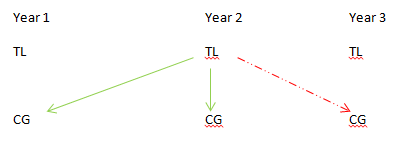
Graphical representation

TL CG Pic


Green arrow shows what can be done.

Red arrow shows what cannot be done.


Example below explains it further:

Say ABC Ltd has been trading for a number of years and below given is the Trading losses and Capital Gains figures for a period of 3 years.

                                                Year 1                   Year 2                   Year 3

Trading Loss (TL)                (30)                        (20)                        (100)

Capital Gains (CG)                 0                              40                           80


Computation of Taxable Income

Year 1

Trading Loss                                       £30

Carried forward Loss                      £30


Year 2

Trading Loss                                       (20)

Capital Gain                                        40

Net taxable Income                           20

Carried Forward Loss                      30

CG cannot be set off against carried forward TL so ABC Ltd pays tax on £20 and carries forward £30 of losses.


Year 3

Capital Gain                                        80

Trading Loss                                       (80)    Only (80) utilised out of (100) for Year 3 rest carried back below

Net taxable Income                          Nil

Carried Forward Loss                      30

Carried back loss                              20


Carried back loss can enable ABC to claim back tax paid in Year 2.

 Contributions
A special thank you to following individuals and organisations:

  • ICAEW and KAPLAN  for creating an excellent study manuals.
  • My colleague Neel to pose the question in a practical format.
  • My colleague Gagan in discussing and crystallizing the graph.