Registering a company as employer with non-UK resident director

Overseas directors and PAYE;
Email address of HMRC Employer helpline

Registering a company as an employer where Directors are from overseas and do not have a National Insurance number.

We need to call HMRC on 0300 200 3200.

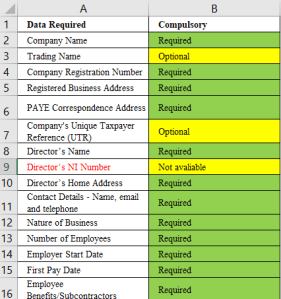
Before calling gather following information:

Email of Employer helpline : employer.helpline@notifications.hmrc.gov.uk

Notes:

  1. Remember to take down details of the HMRC officer with whom you spoke ; refer to :https://www.icaew.com/technical/tax/working-with-hmrc/hmrc-contacts#
  2. HMRC does not register employers at virtual office addresses so please ensure to have physical trading address on hand before calling HMRC.
  3. For an employee who is not in UK and has never been UK tax resident use NT tax code and NIC letter X. See HMRC CWG2 point 4.6.7

Negligible Value Claim (NVC) in SEIS shares

When assets become of negligible value in TP’s (taxpayer) ownership, TP may choose to make a negligible value claim. TP is treated as though he had disposed of the asset and immediately reacquired it at the time the claim is made, for an amount equal to the value which is specified in the claim. 

This is most commonly applied to shares where the company goes into liquidation.1

Claim should be made via a tax return. Date of claim is date of submission of tax return.

Conditions for making a claim are:

  • you must still own the asset when you make the claim2
  • the asset must have become of negligible value while you owned it.

Set capital loss against income

Usually, capital losses are not allowed to be set-off against income, as capital gains are taxed at a lower rate than income tax.

But if certain conditions3 are met NVC loss can be set off against income.

Limit on losses

For losses made in 2013 to 2014 onwards, the total of all Income Tax losses which can be claimed against a year’s income is limited to £50,000, or 25% of that income if greater.

This limit does not apply to losses on shares to which EIS or SEIS relief is attributable. Helpsheet 204 Limit on Income Tax reliefs (2022) explains which reliefs are included in the limit.

Tax return

1. Provide details of negligible value claim in box 54, ‘Any other information’4, on SA108 pages and attach computations with your tax return.

2. Ensure loss is included in boxes 7, 19, 27 or 35 of the SA 108, as applicable, and use code ‘NVC’ in boxes 8, 20, 28 or 36, as applicable, and provide an accompanying computation.

3. To set-off capital loss against income complete Box 41 on SA108.

4. Complete box 42 for losses in shares of EIS or SEIS.

Sample Computation 5 and 6

Deemed disposal proceeds                                                                      £Nil

Allowable costs:

Actual Purchase cost                     £15,000

Less:

Income Tax relief re SEIS               £1,0007                                      £14,000              

Allowable Loss  eligible to be set-off against income                      £14,000

Notes:

  1. Tolley Exam Training 30.4
  2. See Example 1 in HS286.
  3. See HS286 for these conditions.
  4. Information to include in this box is given in ` How and when to claim the relief` section of HS286.
  5. See Example 4 in HS286.
  6. Good computation examples given in Tolley Tax computations 227.2 and 15.5
  7. Assumed less than 50% relief claimed in the year of investment due to insufficient taxable income.

Associated Companies

A simple guide with scenarios encountered by SME practitioners.

Why is it important?

a. Corporation Tax rate

Limits of standard rate (25%) and small profits rate (19%) are divided by number of associated companies plus one.

Example 1: How limits are calculated.
Suppose A Ltd and B Ltd are associates. As A Ltd has one associated company B Ltd, limit will be divided by 1+1 = 2; and reduce from £250k (25%) to £125k and £50k (19%) to £25k.

Corporation tax limits are for 12 months, thus where the accounting period is six months with one associated company, limits will be divided by four.

b. Deadline for Corporation tax (CT) payment

`Large` companies i.e. companies whose annual profits exceed £1.5m, must pay CT by quarterly installments. £1.5m threshold is divided by number of associated companies.1

Who are associates?

Two companies are associates when one is controlled by another or both companies are controlled by the same person or persons.

Example 2: One company owned by another.
A Ltd owns 100% share capital of B Ltd. A Ltd and B Ltd are associates.

Example 3: Subsidiaries
A Ltd owns 50.5% of B Ltd. A Ltd also owns 100% of C Ltd. All three companies are associates.

Example 4: Two different companies fully owned by same person.
Both A Ltd and B Ltd are 100% owned by Mr A. A Ltd and B Ltd are associates.

Example 5: Two different companies 50% owned by same person.
Mr A owns 50% shares of A Ltd and B Ltd. A Ltd and B Ltd are not associates. As the condition is that Mr A has to own more than 50% shares to have control.

Example 6: Two people owning more than 50% shares in two different companies. (Usually husband wife companies). Both A Ltd and B Ltd are owned by Mr A and Mrs B 50% each. A Ltd and B Ltd are associates. Mr A and Mrs B need not be relatives. Even if they are friends A Ltd and B Ltd are associates.

Example 7: Concept of smallest irreducible number
A Ltd owned 50% each by Mr A and Mr B. B Ltd owned 1/3rd each by Mr A, B and C. Smallest irreducible number to control A Ltd is A + B. In B Ltd it is A+B, A+C or B+C. As A+B is common in both companies, they are associated companies.

Example 8: Directorship
A Ltd is 100% owned by Mr A; there are two directors in A Ltd, Mr A and Mr B. B Ltd is 50% each owned by A and B; and both A and B are directors in B Ltd. A Ltd and B Ltd are not associates as Control is at the participator or general meeting level, not at the administrative or board level.

Companies owned by relatives?

They will only be counted as associates if there is substantial commercial interdependence among them.

Example 9: Different businesses

A Ltd is 100% owned by husband Mr A operating an accounting business. B Ltd is 100% owned by wife Mrs B operating an architectural business. If no substantial commercial interdependence, they are not associates.

Inclusions:

  • Overseas companies
  • Company associated even for 1 day in the accounting period.

Example 10: Associates acquired or disposed during the year.
A Ltd accounting period runs from 1st April 2024 to 31st March 2025. A Ltd had one 100% subsidiary, B Ltd, which he disposed on 30th June 2024 and a new 100% subsidiary, C Ltd, was incorporated on 1st March 2025. In this case both subsidiaries will be counted.

Exclusion

  • Dormant companies – usually passive holding companies.

    Example 11: Dormant company
    A Ltd’s year end is 31s Jan 2025. B Ltd,100% subsidiary of A Ltd, is incorporated on 29th Jan 2025. B Ltd commences trading on 15th Feb 2025. B Ltd will not be counted as an associate for A Ltd the year ended 31st Jan 2025 as B Ltd was associate only for part of the accounting period and was dormant in that part.3


Practitioner’s points:

  • Take care when shortening accounting period of companies as it reduces their limits as well.
  • Date of ceasing and commencing trading will become important; as 1 day trade can reduce limits by half.
  • Ownership percentages become more important.
  • Group profits can be shifted via intra-group sales and management charges.4

Notes:

  1. CTM92520
  2. 14.12.5 Tax Planning : Taxation of Small businesses by Malcolm James.

Further readings:

  1. TAX guide 02/23: Associated companies | ICAEW
  2. Associated companies and corporation tax | ACCA Global
  3. AAT FAQs
  4. Taxation of Small businesses by Malcolm James
Annual PAYE process

Year end payroll tasks in simple terms.

In simple terms – annual PAYE process for most employers.

-Send final FPS: this is a check box in the PAYE software which needs to be ticked confirming that it’s the final FPS of the year.

– Issue P60: once step 1 has been completed, we need to issue P60 to all employees employed as at 6th April. Some software send P60s to all employees even those who left. So ensure to exclude the leavers when sending P60s. Also save a copy in your records.

– Submit P11d forms to HMRC and ask employer to pay Class 1A National Insurance. Employee also needs a copy for their self assessment tax return.

– Update Software: all PAYE software must be updated once the tax year ended. Usually the software will prompt you automatically to update it once you logging. Alternatively, visit software provider’s website for instructions.

– Update tax code for the new year: please use HMRC guide P9X for this.

– Update staff salary with National Minimum wage. Adjust director’s salaries where required. Be aware National Minimum wage increases not from 1st April but from first pay reference period starting after 1st April. See ACAS link.

-Review eligibility for Employment Allowance in the new tax year. Also check for connected businesses.

-Review Pay/RTI dates ; sometimes software does not carry it forward correctly.

Bonus points:

1 – Before every payment run employers need to download tax notices from HMRC website. HMRC has made a very good free software – HMRC Desktop Viewer Most software will have an inbuilt facility to download PAYE notices.

2 – We are using MoneySoft payroll for our payroll. We find it easy to use and value for money.

3 – HMRC version of this guide.

4 – Payrolling of benefits delayed by one year to April 2027.

VAT late payment penalties and interest

VAT late payment penalties are changing for VAT periods ending on and after 1st April 2025.

 Penalty
Days after deadlineActionsCurrentwef 1st April 2025
First penalty (Fixed percentage penalty)0-15Pay in full or arrange a time to pay before 15th DayNo penaltyNo penalty
16-30 inclusivePay in full or arrange a time to pay between 16- 30th day2% on outstanding amount at day 153% on outstanding amount at day 15
31 plusPay in full or arrange a time to pay after day 312% on outstanding amount at day 15 plus 2% on outstanding amount at day 303% on outstanding amount at day 15 plus 3% on outstanding amount at day 30
Second penalty (Interest like penalty)31 plusUntill paid in full or arrange a time to payAt 4% per annum for the duration of outstanding amountAt 10% per annum for the duration of outstanding amount

No change in late payment interest rules. Interest charged from due date till payment date at 2.5% plus Bank of England Base rate per annum.

Source

Spring Statement 2025 (HTML) – GOV.UK

Bonus

  1. Payment plan can only be set up if there is no other plan set up.