Beginner’s guide to DTAA

Every nation has sovereign right to tax its residents on their worldwide incomes. This may result in double taxation both in country of residence and country of source.

If there is a conflict between domestic law and treaty, treaty prevails as it’s an agreement between two sovereign nations. `Treaty override` is a case where a state takes a decision to reverse and give priority to domestic law; however, this is quite rare.

DTAA can only relieve tax, can never impose tax.

Rules for reliefs from UK tax are found in Taxation (International and Other Provisions) Act 2010 (TIOPA 2010). This Act complements the Income Tax Act 2007 for matters involving international taxation.

OECD –   sample treaty between two developed nations. Emphasis is on right of `state of residence` to tax.

UN Model – sample treaty between developed and developing nations, to encourage flow of investments from developed to developing nations. A compromise between source principle and residence principle. More weight to source principle. India’s most treaties are based on UN model.

US Model – different clauses from both UN and OECD model.

In order to make use of the treaty the tax payer should be, usually, resident of one of contracting states.

Resident could be different from tax resident as per domestic law, it is defined as `fiscal residence` in the treaty.

We can refer to following sources:

  1. “shall be taxable only” or “may be taxed”

“shall be taxable only” means taxable only in one state.

Example: UK India DTAA Article 19.2 states “Any pension paid by the Government of a Contracting State to any individual in respect of services rendered to that Government shall be taxable only in that Contracting State “i.e. Pension payable by Government of India (GOI) to an individual for services rendered to GOI, this pension income will be taxable only in India, even though individual getting the pension is resident in UK.

“may be taxed” means can be taxable in both countries; unless restricted by other Articles of the DTAA.

Example: UK India DTAA Article 6.1 states “Income from immovable property may be taxed in the Contracting State in which such property is situated” i.e. rental income from a property situated in India can be taxable in India and also taxed in UK.2

This is the main reason for DTAA.

There are two methods of elimination:

  1. Exemption
  2. Credit Method

1. Exemption Method

1.1 Full Exemption: Income earned in one state is fully exempt in other.

1.2 Exemption with Progression: foreign income is considered only for the tax rate purpose.

2. Credit Method

2.1 Full credit: Total foreign tax paid is allowed as a credit against tax payable.

2.2 Ordinary Credit: Credit allowed only to that part of income tax which is attributable to the income taxable in the state of residence. Usual method in UK treaties.

2.3 Tax sparing: Credit allowed for foreign tax deemed paid. Read our blog UK India DTAA NRE interest income.

Helpful numerical examples given in Tax and Treaty Guide by NK Bhat, Yogesh Thar and Mayur Nayak of Bombay Chartered Accountants’ Society

Another helpful book with examples – Interpretation and application of Tax treaties by Ned Shelton [Tolley International Series].

  1. US UK treaty Article 11 Interest states – Interest arising in a Contracting State and beneficially owned by a resident of the other Contracting State shall be taxable only in that other State. Explanation note states Paragraph 1 generally grants to the State of residence the exclusive right to tax interest beneficially owned by its residents and arising in the other Contracting State.
  2. See similar provision in US UK treaty Article 6 and explanation notes state – This Article does not grant an exclusive taxing right to the situs State; the situs State is merely given the primary right to tax.

UK India has a separate treaty for IHT ; link here.

OECD – Model Tax Convention on Income and Capital

DT Digest

DT Relief Manual

International Manual

Residency, Domicile and Remittance Basis Manual

Tax Treaties

DT Individual Formy

Details of MAP process and who to contact to request MAP assistance

SA Help-sheet Links

HS302 – Dual Residents

HS304 – Non-Residents – Relief under Double Taxation Agreements
HS263 – Calculating Foreign Tax Credit Relief

SA106 – Foreign Income Notes

SA109 – Residence Notes

Private pension contributions

Things to be aware of when contributing towards private pension.

  1. Upcoming changes: New Labour government has proposed that from April 2027, most unused pension funds and death benefits will be included within the value of a person’s estate for IHT purposes. This removes an exemption that could have saved IHT of up to 40% of the value of the pension fund.1

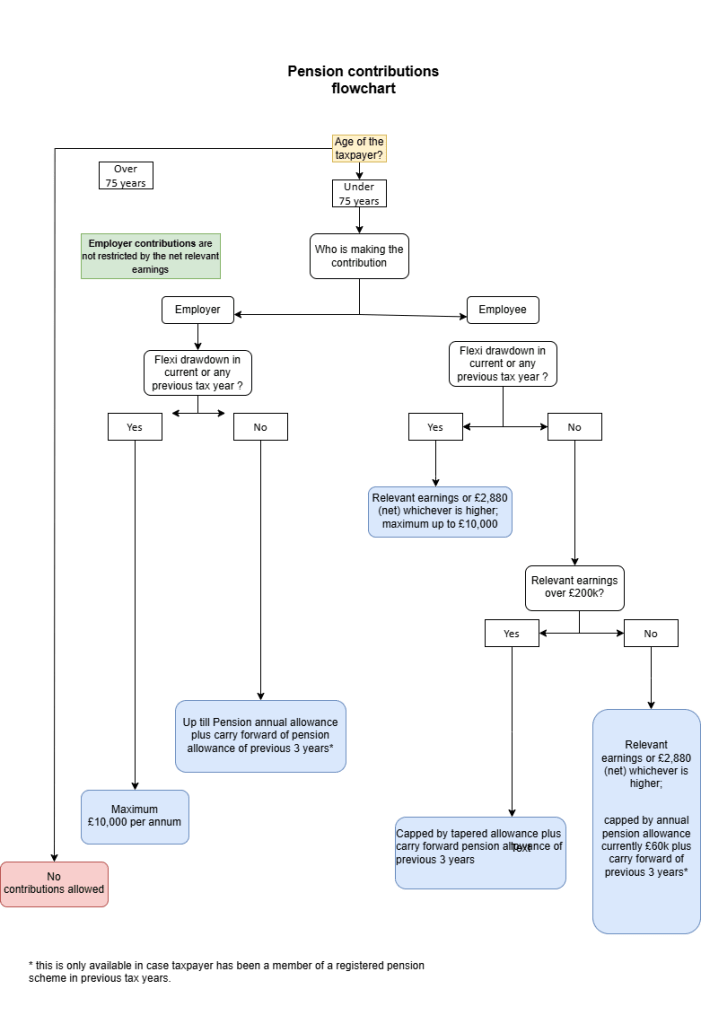
  2. The maximum amount of contributions (subject to Pension annual allowance below) on which a member can have tax relief in any tax year is potentially greater of:
    – the ‘basic amount’ – currently £3,600 (gross), or
    – the amount of the individual’s relevant UK earnings that are chargeable to income tax for the tax year.

    Example : Individual’s annual salary is £12,000. Maximum net can put in his pension is £12000 x 0.80 = £9,600 because with HMRC relief of 20% of £2,400 (£12,000-£9,600) gross becomes £12,000.

    Pension income– either from a defined benefit, defined contribution or the State Pension – isn’t classed as relevant UK earnings.2

For a detailed list of what is classed as relevant earnings see PTM044100.

Employer contributions are not restricted by the net relevant earnings. 3 But again restricted by Pension annual allowance below.

3. Pension annual allowance: Maximum amount a tax payer can deposit in pension in a year is £60k4. This amount includes Employee contribution, Employer contribution and HMRC Relief5.

Carry forward: This allowance can be increased by any unused annual allowance of the previous three tax years6, this is only available in case taxpayer has been a member of a registered pension scheme in previous tax years.

Taper: If annual income of the tax payer goes over £200k, they should calculate Tapered Annual allowance. Use our excel tool to calculate it.

Flexi access: If taxpayer withdraws funds under ‘flexible drawdown arrangements’ from his pension annual allowance is restricted to `money purchase annual allowance` (MPAA) currently £10,000. 7 Once tax payer accesses pension flexibly MPAA calculation will need to be done for that and every subsequent tax year.10 For example calculation see PTM056540 or Tolley Tax computations 19.3 D. Also note carry forward allowance are not added to MPAA.11

4. Age: Contributions are not permitted by taxpayers over the age of 75. 8

5. Time limit: Pension contributions need to be actually paid within the tax year. Tax relief can only be claimed in the tax year in which payment is made. There is no provision to carry back or forward to other tax years.9

6.Tax free lumpsums: Life time allowance was abolished from 6 April 2024. But Tax free lump sum allowance is still £268,275 [25% of £1,073,100 (lifetime allowance)]. But this may be higher if you hold a protected allowance.

7. Tax planning:
a) An individual with only investment income can still save £2,880 (net) and get £20% back from HMRC in his pension pot + increase his basic rate band.

b) Additional savings can be made by individuals with income at margins of income tax rate bands e.g. an individual earning just above £50k or £100k.


Source:

  1. Inheritance Tax on pensions: liability, reporting and payment – GOV.UK
  2. PTM044100
  3. Tolley Exam 29.7
  4. Pension schemes rates – GOV.UK
  5. Tolley Annual Income tax 56.24
  6. Tolley Exam 29.8
  7. Tolley Exam 30.3
  8. Tolley Exam 29.4
  9. Alan Melville Pg 206
  10. Tolley Annual 56.23
  11. HS345 Pension savings — tax charges which includes a calculator.

Employer: Paper PAYE notices

How to Stop paper PAYE notices

Update December 2024

HMRC has advised of the new process via Employer bulletin Dec 2024.

April 2020

I noticed some customers PAYE tax notices for employees come in post while others we can download via our software directly.

I realised there was an issue with the settings.

To resolve this issue follow the following steps:

  1. Login to HMRC agent > PAYE for employers.
  2. Click Change notice options
  3. Apply to all clients
  4. Put YES in all options on this page.

That’s it.

Now after couple of days you can start downloading all notices via software.

Good luck !

Excel tool to compare Self employed vs Ltd company taxes

Please drop me an email if you find any errors or wish to suggest any improvements.

Calculator Disclaimer

Anyone can use this calculator free of charge. The results provided by this calculator are for informational purposes only and are not intended as financial, legal, or professional advice. While we strive to ensure the accuracy and reliability of the calculations, we make no guarantees regarding their correctness or applicability to your individual circumstances.

By using this calculator, you acknowledge and agree that any reliance on the results is at your own risk. We recommend consulting with a qualified professional before making any decisions based on the information provided.

Roy Accountants Ltd is not liable for any losses or damages arising from the use of this calculator or the information it generates.