Blog

EPOS and VAT for restaurant trade

Almost all of the sales made by a restaurant are standard rated for VAT.

Last year we had a client who refurbished his restaurant and had a VAT reclaim. During the course of enquiries VAT Inspector pointed out that Output VAT to Sale was slightly lower than 20%. The difference was of few basis points.

It was curious we had never so closely looked at the Output VAT report and were intrigued as to how this error was happening. After detailed investigation by my colleague – Neel.

We found that there had been a recent menu change and the staff who created the Menu in the EPOS system forgot to tick on one of the items that VAT is applicable.


Moral of the story
From that day we started tracking VAT on a daily basis in all our restaurant clients.

 
Result
Recently we took a new restaurant client and as we started doing our reconciliations immediately we realised that a similar error has been done in this restaurant. We immediately informed the management and rectified the error.

Risk

As any uncollected VAT has to be paid by the restaurant from its own pockets.


Source:
VAT notice 709/1

Holiday pay – restaurant trade

Simple guide to holiday pay

Usually in the UK all workers are entitled to minimum of 5.6 weeks of paid holiday per year. Eight Bank holidays can be included in this and usually they are, as restaurants are open during bank holidays.

How many days are equal to 5.6 weeks?

Full time worker

Workers mostly work 5 days a week with two days off. Thus the calculation of 28 days comes by 5.6*5 = 28 days. Please note even if a worker works six days a week maximum entitlement is 28 days.

Another quick calculation method is for every month worked by a worker his entitlement
is 28 ÷ 12 = 2.33 days.

Part time worker

Entitlement reduces accordingly, for example a worker who works 3 days a week:
5.6 x 3 = 16.8 days.

Hourly worker

They get 12.07% of hours worked. Suppose a worker worked 100 hours, they get 12 hours 4 minutes of holiday pay.

How this percentage of 12.07% came about?

Total number of weeks in a year                                               52 weeks
Holiday entitlement                                                                       5.6 weeks
Working weeks                                                                                46.4 weeks

Percentage                                                                         5.6 ÷ 46.4 = 12.07%

Tool

Use holiday entitlement calculator on Gov.uk site for more clarity.

Source:
Gov.uk website


Bonus facts:

  1. Only time a worker can be paid monies instead of been given holidays is when they leave the job.
  2. Written contracts should be given to workers within two months of starting the job.
  3. Employment contract should contain a clause of deducting excess holiday pay otherwise deduction from pay is not allowed.
  4. ACAS provides help and information to both employers and employees and also provides free e-learning tools.
  5. Sometimes question of rest- breaks also come up. There are three types of rest- breaks:


Rest- breaks at work 20 minute rest- break during their working day, if they work more than 6 hours a day.
Daily rest 11 hours rest between shifts
Weekly rest uninterrupted 24 hours without any work each week


There is no entitlement for paid rest-breaks.


For more details see gov.uk website

VAT on Vouchers issued by restaurants

New VAT rules for vouchers coming from 1st January 2019

VAT rules are changing from 1st January 2019 for vouchers.

The rules are not concerned with if VAT is due, they concern when it’s due.

New rules apply to any vouchers issued on, or after, 1 January 2019. This legislation only affects vouchers for which a payment has been made and which will be used to buy something.

Vouchers are divided in two types.

Single purpose vouchers (SPV) – A voucher where the place of supply and VAT rate is known.
VAT will be due at the time of payment for the voucher – not at redemption.

Multi Purpose Vouchers – MPVs – A voucher which is not a single purpose voucher. These are effectively gift vouchers, where a payment has been made but the exact nature of what is to be provided is not known at the time of payment.


How restaurants will be effected?

Restaurants usually issue SPVs.

Presently, VAT arises when the voucher is redeemed.

Example, if a restaurant sells a voucher for £100 to a customer via an intermediary which acts as the restaurant’s agent. The customer pays the £100 to the intermediary, which passes the money back to the restaurant after having deducted its £5 agent’s commission.  The intermediary also gives an invoice for its commission to the retailer.

The customer goes into the restaurant and spends £150, he pays his bill by redeeming £100 voucher and rest in cash.

The accounting will be as follows:

~ The intermediary will charge the retailer output VAT on the £5 commission which is consideration for its intermediary services.  The intermediary will also be able to deduct any input VAT on its expenditure in providing the intermediary service;

~ The retailer will charge output VAT on the total bill of £150 when the voucher is redeemed in its shop.  It will also deduct the input tax on the intermediary’s commission charge.


From 1st January, 2019 :

VAT will arise when the voucher is sold to the customer.

The accounting will be as follows:

~ The intermediary will charge the retailer VAT on the £5 commission which is consideration for its intermediary services.  The intermediary will also be able to deduct any input VAT on its expenditure in providing the intermediary service;

~ The retailer will charge output VAT on sale of voucher of £100. It will also deduct the input tax on the intermediary’s commission charge.

~ When the customer comes to redeem the voucher. Restaurant will out charge output VAT on £50 as it has already charged VAT on voucher part of the consideration.


Conclusion

We accountants will have to change some processes to correctly account for VAT. We will also need to speak with EPOS providers to amend their systems to ensure correct VAT is charged to the customer on sale of goods and services.

Transition – we will have to be mindful of treating vouchers issued before and after 1st January 2019 differently.


Source:

HMRC Consultation document
Taxation of Political parties: India and UK

A comparison of taxation aspects of political parties in India and UK

India

As an individual coming from India, I was used to seeing the political class enjoying all kind of privileges. As an accountant I came to know early in my career that political parties in India are exempt from paying tax.

Also, donations made by individual or company are also allowed as deductions under section 80 GGC and 80 GGB respectively on the Indian Income Tax Act.

India recently introduced a new way of funding political parties called `Electoral bonds`. Under this new system – donor, recipient and amount all will remain unknown and yet according to the Government it will increase transparency.

I will not give any glowing example of political donation scandals in India due to limitation of memory of my computer and time at my hands.


United Kingdom

Political parties pay tax on their income in the UK.

Further, Donations made to political parties are not allowed as deductions in in calculating the profits of a trade as they are almost always made wholly or partly for non-trade purposes. (BIM 47405). See also Taxation query.

This is not to say political parties do not get donations in the UK and if they get they do not get influenced by them. Transparency International UK has highlighted the case of Lycamobile.

Also, see Reuters article on how wealthy individuals are donating via their companies and avoiding tax but HMRC is avoiding to look into this difficult question.


Conclusion

I draw your attention to the facts. Please draw your own conclusions.


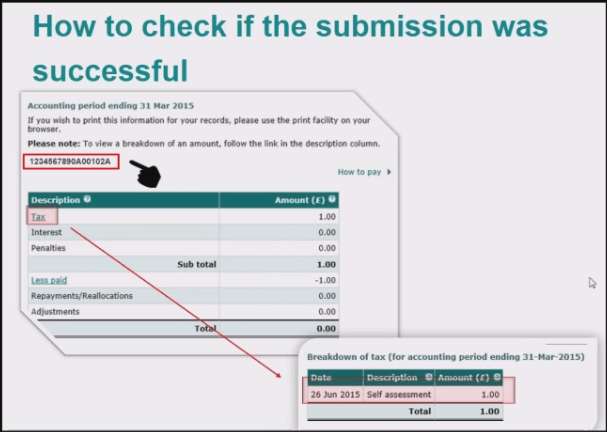
CT600 – How to check if submission was successful

Software gives us the confirmation but if you wish to check if HMRC has received it and successfully processed it.

Go to online account to the below screen and if the Tax has a hyper link as shown below – yes, the tax return has been successfully received and processed by HMRC.

How-to-check-if-CT600-submission-sucessful


Bonus facts

a- Client’s bank account details must be provided in every CT600.


Source:

HMRC webinar on Common filling errors . HMRC runs a series of fantastic webnairs. Click here for more details.