FATCA and bank accounts

What is FATCA ?

Foreign Account Tax Compliance Act (FATCA), effective as of 1 July 2014 is a law of United States.

 What is the use of FATCA ?

This law is primarily designed to tackle tax evasion by US Citizens and US Companies who keep their savings and investments overseas and do not inform Internal Revenue
Service (Tax department of US Government)

 Am I affected?

Yes.

Many countries (like UK) in the world have signed `Inter-governmental agreements` with US Government.

This means all banks operating in the UK have to comply with FATCA provisions.

If you open personal or business bank accounts your bank will ask you to fill in a form. You may wonder why you need to complete this form as you have no connection with the US.

The issue here is, you know that that you have no connection with US but your bank does not know that. You are being asked to complete this form as a confirmation that you have no connection with the US.

Form filling

Most of the forms are straight forward but form W-8BEN-E is a bit complex thus I thought I will write about it.

Part 1 – Identification of Beneficial Owner 
1 –  Enter name of your company like ABC Limited
2 –  Country of incorporation e.g. United Kingdom
3 –   Usually left blank
4 –  Tick Corporation for a simple limited company.

5 –  Most of the legal entities (Companies, partnership, trust etc) in the UK with no connection with US, will be classified as Active Non-Financial Foreign Entity (NFFE) i.e Part XXV.
6  and 7 – as appropriate.
8 – US TIN – Normally you may not have a US Tax Identification number, so leave blank.
9a – Leave blank
9b – HMRC’s UTR number.
10 – Leave blank
Part 2 till Part 24 leave blank
Part 25 – Tick the box
Part 26 till Part 29 leave blank
Part 30 – Sign, name and date in American format (mm/dd/yyyy)

Bonus

I will not repeat what my ex-colleagues at HSBC UK have explained very well already. Please visit their website by link given above.

Note – This article is written as a very simplified guidance to FATCA, your circumstances may be different. Please go to IRS website (click here) to get more information.

Buying a van – should I buy in company or individual name?

Van

Simple advice is buy through your company.

VAT – if your company is VAT registered, you can claim VAT on the purchase.

Corporation Tax – You will be able to claim Capital allowances on purchase price.

Income Tax – No taxable benefit arises if a van is made available to an employee (including a director) mainly for business use and the employee is not allowed to use the van for private journeys other than ordinary commuting between home and work.
See ITEPA 2003 Section 155 (5)


Bonus points:

  • Ensure you are buying a van not a car – HMRC has a useful list
  • Paperwork – ensure the paperwork is in company’s name and all payments go out of company’s bank account.

Relief for Trading Losses with Capital Gains

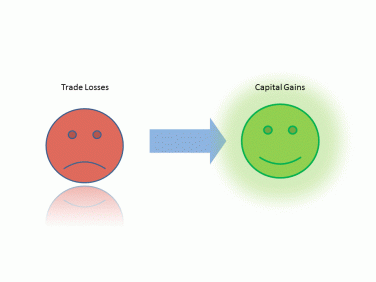
Trade Losses set of with Capital GainsThere are three ways in which Trading Losses can be set-off:

  1. Set against total profits in the current accounting period. CTA 2010, s.37(3)(a)
  2. Carry back and set against total profits in the preceding 12 months. CTA 2010, s.37(3)(b)
  3. Carry forward and set against next available future trading profits from the same trade. CTA 2010, s.45(4)

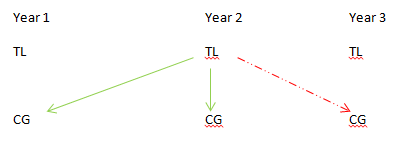
Graphical representation

TL CG Pic


Green arrow shows what can be done.

Red arrow shows what cannot be done.


Example below explains it further:

Say ABC Ltd has been trading for a number of years and below given is the Trading losses and Capital Gains figures for a period of 3 years.

                                                Year 1                   Year 2                   Year 3

Trading Loss (TL)                (30)                        (20)                        (100)

Capital Gains (CG)                 0                              40                           80


Computation of Taxable Income

Year 1

Trading Loss                                       £30

Carried forward Loss                      £30


Year 2

Trading Loss                                       (20)

Capital Gain                                        40

Net taxable Income                           20

Carried Forward Loss                      30

CG cannot be set off against carried forward TL so ABC Ltd pays tax on £20 and carries forward £30 of losses.


Year 3

Capital Gain                                        80

Trading Loss                                       (80)    Only (80) utilised out of (100) for Year 3 rest carried back below

Net taxable Income                          Nil

Carried Forward Loss                      30

Carried back loss                              20


Carried back loss can enable ABC to claim back tax paid in Year 2.

 Contributions
A special thank you to following individuals and organisations:

  • ICAEW and KAPLAN  for creating an excellent study manuals.
  • My colleague Neel to pose the question in a practical format.
  • My colleague Gagan in discussing and crystallizing the graph.

Tronc : Tips and service charges in Restaurant /Pub trade

HMRC has given its guidance in publication E24.

Tronc is special arrangement allowed by HMRC for catering trade to distribute tips received from customers.

Main takeaways from the guidance are as follows:

1- If tips are optional, no VAT is to be charged.

2- Income tax is to be deducted from tips in all circumstances.

3- NIC is not due on tips (extract from PAYE 72080), if :

A – Customers pay tips direct to employees and the employer is not involved; or

B – i) Customers pay voluntary service charges and / or tips to the employer; and

ii) The employer passes some or all of the charges / tips to a tronc; and

iii) The employer is not involved in deciding how much each tronc member receives from the tronc.

4- Employers must pay their staff at least National minimum wage in addition to tips.

In effect Tronc system saves National Insurance Contributions of both employer and employee.

Also , see recent ICAEW Webinar

Key takeaways from ICAEW Webnair:

  • Its usual to maintain around one month of reserve in Tronc.
  • We need inform HMRC when a new Tronc scheme is set up and who is the Troncmaster. Ensure to mention in the letter to request HMRC not to open another PAYE Scheme.
  • Every time Troncmaster changes we should inform HMRC.
  • Tronc is not subject to auto-enrollment pensions.
  • Some restaurant put cover charges on the bill. These are mandatory so VAT is charged on these plus not part of Tronc system.
  • Service charge belongs to the Business this was decided in European Court of Human Rights in Nerva and others v United Kingdom [2003] 36 EHRR.
  • Troncmaster can be and usually is appointed by the employer.
  • In practice credit card tips are processed through Tronc. Cash tips are distributed by staff among themselves. As a good practice employer should add a note to payslip to remind employees that cash tips are taxable income and they should declare it to HMRC seperately.

Also further guidance is given in HMRC National Insurance Manual – NIM02900CO
Accounting for Forward Contracts for SMEs

Our client sell items in Eurozone and collect sale proceeds in Euros. They buy from China thus need Chinese Yuan to make payments to their suppliers.

Say on 1st April 2020 Client entered in a forward exchange contract to sell €10,000 and buy Yuan with settlement date of 30th June 2020. When they enter in the forward contract their bank American Express asks them to deposit 10% as a security.

At 1st April 2020 – Contract signed + deposit paid

  • No accounting entry needs to be made for contract signed.
  • Accounting entry for deposit is simple.

Dr           Deposit                  €1,0001
Cr            Bank                      €1,000

Note 1. We will need to open this deposit account in Euros in the accounting software.

At 30th June 2020 – Settlement Date

Date Spot Rate Forward Rate 30th June 2020
1st April 2020 7 9
30th June 2020 8 8

Step 1: Calculate the profit or loss on forward.

  Yuan Rate
Forward Contract ¥ 90,000 1 : 9
If bought in spot market ¥ 80,000 1 : 8
Gain ¥ 10,000
Gain in Euro €1,250 1:8

Step 2: Accounting Journal entry that needs to be passed

Dr           China Bank Account        €11,2502
Cr            Bank                                      €9,0003
Cr            Deposit                                 €1,0004
Cr            FX Gain/loss                         €1,2505

Notes

  1. We will post this transaction with FX rate of 8 Yuan to 1 Euro.
  2. We will need to give balance amount to fulfil our obligations before bank gives us ¥90,000.
  3. Deposit will be used up as part payment.
  4. As calculated earlier.