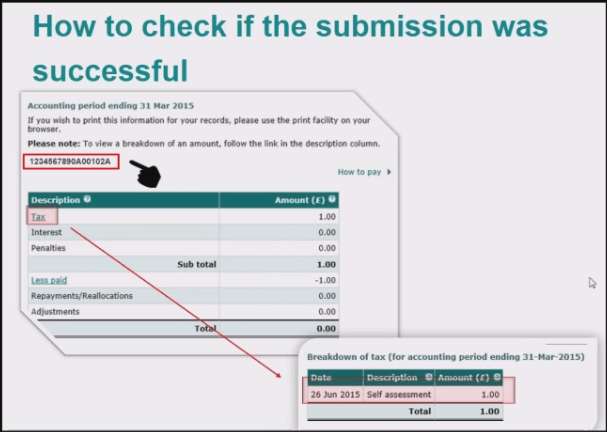
CT600 – How to check if submission was successful

Software gives us the confirmation but if you wish to check if HMRC has received it and successfully processed it.

Go to online account to the below screen and if the Tax has a hyper link as shown below – yes, the tax return has been successfully received and processed by HMRC.

How-to-check-if-CT600-submission-sucessful


Bonus facts

a- Client’s bank account details must be provided in every CT600.


Source:

HMRC webinar on Common filling errors . HMRC runs a series of fantastic webnairs. Click here for more details.


Payments in lieu of notice (PILON)

What is PILON?

PILON is a payment made to an employee when employment is terminated without notice, instead of the employee working through a notice period and receiving pay in the normal way.

It is different from ‘gardening leave’, in which the employee is still in employment during the notice period and is paid during that period, even though he or she is not present at work.


What has changed?

Tax laws have changed regarding PILONs from 6th April 2018.

All payments in lieu of notice on, or after 6 April 2018 are chargeable to income tax and Class 1 National Insurance Contributions (NICs), whether or not they are contractual payments.


Notes:

Please note this applies to basic pay only i.e. anything paid over and above this, we can use the £30k threshold.

PILON payments will not benefit from £30,000 threshold.

Statutory redundancy payments are not PILON payments and they benefit from the £30k threshold.

If an employer pays more than the PILON the remaining balance should be tax free up to the first £30,000.


Sources:


Loss reform – Corporation tax

Carried forward losses can now by surrendered via Group relief

Current law

Carried-forward losses can only be used by the company that incurred the loss, and not used in other companies in a group. Additionally, certain losses can only be set against certain types of income, for example trading losses can only be used against trading profits.


New Law

Losses arising after 1st April 2017 can be set off against own and group company profits. Type of income restriction is also removed.

There is a new loss restriction i.e. only 50% of the carried forward losses can be relived. Don’t worry there is an annual threshold of £5 million for each standalone company or group, ensuring 99% of companies are unaffected by the restriction.


Additional notes:

  1. Capital losses not effected by these new rules.
  2. Losses expire when trade closes.
  3. A company can only surrender losses under group relief after its has used its own carried forward losses against its current year’s profit to the full extent.
  4. Similarly, company claiming losses under group relief has to first exhaust its own carried forwarded losses before claiming any under group relief.
  5. Group Allowance allocation statement is also required.


Source:

  1. Basic guidance in simple English – see HMRC note.
  2. HMRC has recorded a webinar on this topic – click here. Then Ctrl + F > “reform”.

Example of Property Income: Interest deduction

In 2017/18, if a landlord incurs loan costs on a let dwelling, the allowable deduction is only 75% of the cost. The remaining 25% gets tax relief at 20% in the income tax calculation.

  • This restriction does not apply to furnished holiday accommodation.
  • This also does not apply in case landlord is a company.
  • This applies only in case of residential property.

Example

Jack has employment income of £26,000 and rental income of £20,000. Costs are loan interest of £2,000 and other allowable expenses of £3,000.

£
Employment 26,000
Property £(20,000-(75% x 2,000) – 3,000 15,500
Personal allowance (11,500)
Taxable Income 30,000
Income Tax £30,000 x 20% 6,000
Less tax reducer £(2,000 x 25%x 20%) (100)
Income tax liability   5,900

Apologies, I lifted this straight out of ICAEW Vital magazine. I could not resist seeing such a simple and beautiful example.

Conclusion:

Basically, this change effects only tax payers whose total income goes over higher rate threshold (i.e. £46,351 for the tax year 2017-18) without deducting finance cost.

Example 1 : John has salary income of £30k and rental income of £15k and finance cost of £10k. John’s total income without deducting finance cost is £45k , this is below £46,351 thus no effect for John.

Example 2  : Jane has salary income of £30k and rental income of £25k and finance cost of £10k. John’s total income without deducting finance cost is £55k , this is above £46,351 thus this will effect Jane.

To learn how it will effect, see HMRC guidance.

Bonus fact:

  1. HMRC guidance mentions 82% of landlord will not be effected as their total income, without a deduction for finance costs, does not exceed the higher rate threshold.
  2. In tax year 2016-17, out of UK adult population of 53.2 million , c 30.2 million were tax payers (57% of adult population). Around 4.4 million (8%) were paying tax at 40% and 333k (0.6%) tax payers are in 45% tax bracket. Click here for Source.
  3. As per BBC article date June 2017. There are 15k individuals with incomes over £1m and 4k over £2m.

National Minimum wage (NMW) a matter of months

What should be NMW for an employee who is 20 years and x months old.

My colleague Neel was working on a client and asked me this interesting question.

What should be NMW for an employee who is 20 years and x months old.

NMW is given in terms of whole years like

25 years and over                            £7.83

21 to 24                                                £7.38

18 to 20                                                £5.90

As always HMRC has been kind enough to make a manual about NMW and share it with us.

See link NMWM03050.

Its states that the worker should be paid £5.90 till he reaches his 21st birthday.